
Week two of every baby massage course is the tummy week, and it is the one parents arrive early for. If your evenings currently involve a lot of pacing up and down the hallway, this is the week that tends to change things.
Can you really rub a baby’s tummy to help with wind?
Yes, and it is one of the oldest tricks there is. A baby’s digestive system is brand new and still learning its job. Air gets swallowed during feeds, it gets stuck, and because your baby spends most of their life lying down, it does not shift on its own the way it would for you or me.
Gentle, warm, rhythmic pressure over the tummy, always in the direction the gut actually runs, helps that trapped air move along. It is not magic and it is not a cure. But it gives you something calm and purposeful to do at half past six in the evening, which matters more than people realise.
Before you start
- Wait about half an hour after a feed. Tummy work on a full stomach comes straight back up.
- Warm the room and warm your hands. Cold hands will end the session before it starts.
- Use a plain, unscented vegetable oil and patch test it on a small area first. We avoid nut based oils completely because of allergy risk.
- Ask your baby first. This sounds daft. It is not. Cup your hands over their tummy, catch their eye, and see what they do. Over a few weeks they learn what is coming, and you learn to read the answer.
The strokes I teach in week two
All of these go clockwise, from your baby’s left to their right as you look down at them. That is the direction the large intestine runs, and going the other way is working against it.
Warming hands
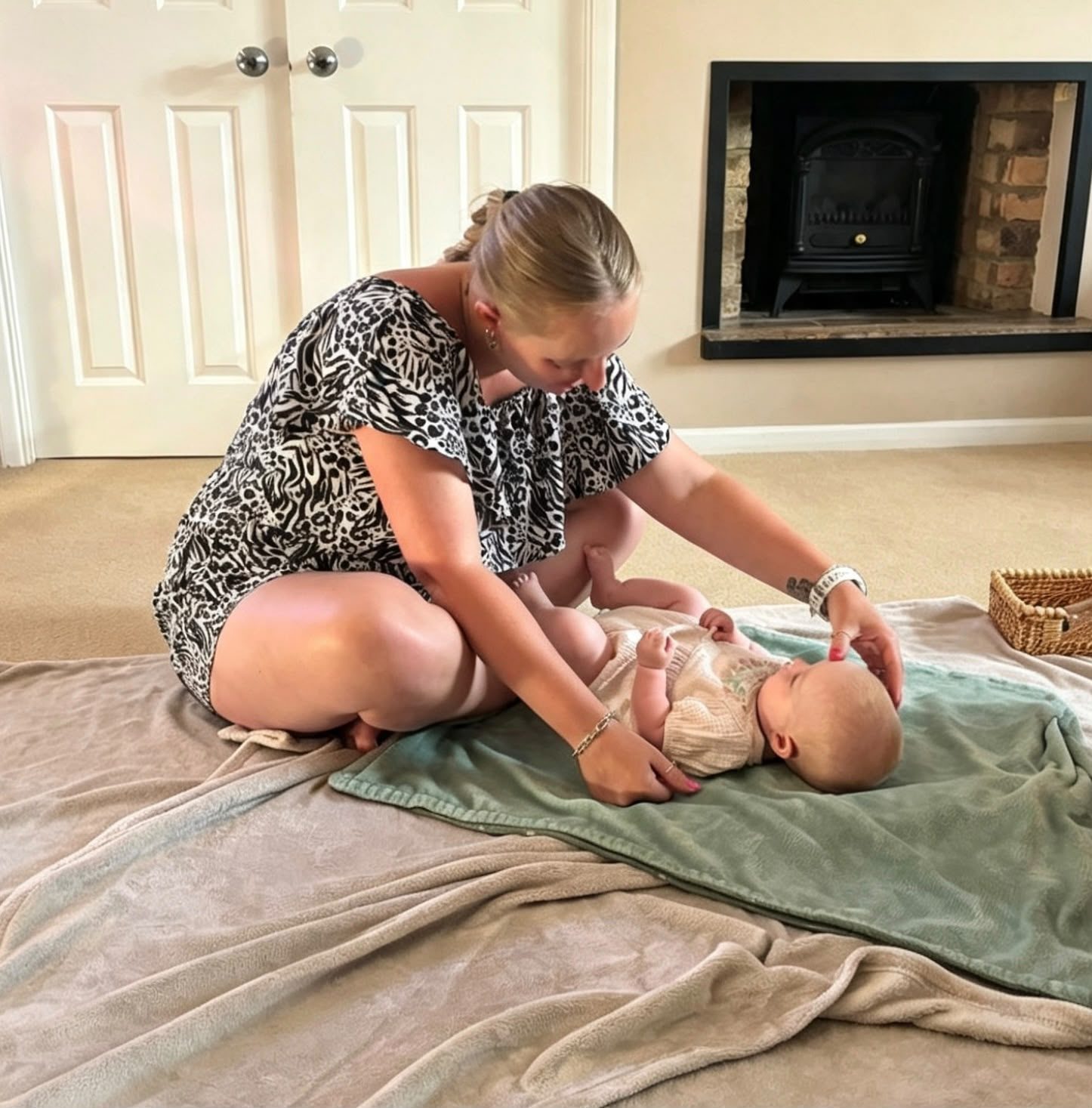
Rest one whole warm hand flat on the tummy, below the ribs and above the nappy. Do not move it. Just let it sit there for a few breaths so your baby knows where you are. This alone settles a lot of babies.
Paddling
Using the flat of one hand and then the other, stroke gently down the tummy, one hand following the other, like slow paddles. Soft pressure, unhurried, six or eight times.
Clockwise circles
With the pads of your fingers, make slow circles around the belly button, clockwise. Think of the pace of a clock’s minute hand rather than its second hand. This is the one most parents go home and use that same night.
Knees to tummy
Hold both ankles, bring the knees up gently towards the tummy, hold for a count of three or four, then let the legs stretch out again. Repeat a few times. Be led entirely by your baby here. If the legs resist, let them.
Finishing
Come back to that still, warm hand resting on the tummy. Beginning and ending the same way every time is what turns a set of strokes into a routine your baby recognises.
How quickly does it work?
Sometimes immediately, and it is very satisfying when it does. More often it is cumulative. Doing it at roughly the same time each day, particularly before the difficult stretch of the evening, tends to help more than doing it once in desperation at ten at night.
What I would really like you to take from it, though, is the calm. On the evenings when nothing works, having something steady and familiar to do with your hands changes how the whole thing feels. Your baby picks that up from you.
When to stop and ring somebody
Stop the massage and speak to your health visitor, GP or 111 if your baby has a temperature, is being sick a lot or forcefully, has blood in their nappy, is not feeding, is difficult to wake, or if the crying sounds different from their usual and you are worried. Colic is very common, but a parent’s instinct that something is not right is worth more than any routine I can teach you. Please act on it.
I am a childcare professional and a baby massage instructor, not a medical practitioner. Nothing here replaces advice from your health visitor, GP or the NHS.
Come and learn it properly
Reading strokes on a screen is one thing. Doing them with somebody watching your hands and saying “a bit slower, and lower down” is quite another, and it is the difference between trying it twice and actually using it.
Tummy week is week two of the Cuddle Cocoon baby massage course in Medway. You can book a place or have a look at the upcoming dates.